
The Real Reason You Feel Unsafe with Money
We’ve been told that money is a numbers game — that if we just budget better, spend less, and “stick to the plan,” we’ll feel safe and free.
But here’s the truth no one teaches us in school or spreadsheets:
Money isn’t logical. It’s emotional. And your body, not your budget, is in charge.If you’ve ever tried to save and ended up spending when stress hit…
If you’ve ever made more money and somehow still felt anxious or depleted…
If you’ve ever felt guilt, fear, or shame around money — even when things are “fine” on paper —
you’re not broken.
Your nervous system is simply doing its job: trying to protect you.
The Myth of Financial Control
Traditional financial advice focuses on control — track every dollar, stay disciplined, restrict yourself.
But for a nervous system that’s already in survival mode, control feels like safety… until it doesn’t.
You can’t spreadsheet your way out of dysregulation.
When your body doesn’t feel safe, no amount of logic or planning will create stability.
Think about it: your body doesn’t know the difference between being chased by a lion or being chased by an unpaid bill.
Both activate the same survival pathways — cortisol spikes, adrenaline floods, and your brain shifts from clarity to reactivity.
In that state, we don’t make conscious choices.
We react.
We spend to soothe, over-work to feel safe, or freeze and avoid the numbers altogether.
This is why you can know what to do financially, yet still not do it.
It’s not a mindset problem — it’s a safety problem.
The Four Survival Patterns That Show Up With Money

Your nervous system has four main protection strategies: fight, flight, freeze, and fawn.
They’re brilliant adaptations — survival responses that once kept you safe.
But over time, these responses evolve into protector parts that try to manage adult life (and money) through the same childhood survival lens.
Let’s meet them 👇
FIGHT — The Controller
This part learned early on that safety came from being in charge, staying ahead, or “getting it right.”
As a child, control created predictability in unpredictable environments.
Now, as an adult, she tries to create that same sense of safety through money.
💰 Money Behavior:
Over-managing every penny.
Micromanaging income, expenses, and others.
Checking accounts multiple times a day.
Feeling anxious if things aren’t perfectly planned.
Beneath her precision is fear: “If I stop controlling, everything will fall apart.”
💬 Nervous system state: Fight — hyper-arousal, tension, overfocus.
💓 What she really needs: Permission to soften, trust timing, and know that safety can exist without control.
FLIGHT — The Over-Achiever
This part learned that love and safety were earned through performance.
Rest felt risky — slowing down meant you could “fall behind.”
So she runs, always reaching for the next financial milestone to feel worthy.
💰 Money Behavior:
Chronic busyness.
Taking on more clients, projects, or goals “to feel secure.”
Believing “once I make X, I’ll finally relax.”
But the goalpost always moves — because the body never lands in enoughness.
💬 Nervous system state: Flight — sympathetic arousal, forward rush.
💓 What she really needs: Stillness that doesn’t equal danger. To experience safety without earning it.
FREEZE — The Avoider
This part formed when the overwhelm felt too big to process.
As a child, checking out or disappearing was the safest option.
Now, when money feels heavy or confusing, she goes numb.
💰 Money Behavior:
Avoiding the bank app.
Procrastinating on bills, taxes, or decisions.
Feeling “frozen” when it’s time to look at finances.
This isn’t irresponsibility — it’s the body saying, “This feels too much right now.”
💬 Nervous system state: Freeze — hypo-arousal, collapse, dissociation.
💓 What she really needs: Gentle, titrated steps to re-engage. To rebuild trust in her ability to handle what’s in front of her.
FAWN — The People-Pleaser
This part found safety through harmony.
She learned to meet others’ needs to stay loved or avoid conflict.
As an adult, she often trades her financial peace for connection.
💰 Money Behavior:
Under-charging or over-giving in business.
Picking up the bill to avoid tension.
Loaning money you don’t have.
Feeling guilt when setting boundaries or saying no.
Her core belief: “If I make everyone else happy, I’ll be safe.”
💬 Nervous system state: Fawn — blended appeasement and freeze.
💓 What she really needs: Boundaries that affirm, “I can love others and stay safe in my own body.”
Each of these protectors was formed in innocence — to help you survive.
Now, through awareness and regulation, they can rest.
Because when your body feels safe, you no longer have to fight, flee, freeze, or fawn your way into financial security.
You become the safety your system was always searching for.
The Body’s Definition of Safety
Safety isn’t a thought. It’s a sensation.
You can tell yourself “I’m fine” all day long — but if your body still feels like it’s bracing for impact, your subconscious will override every financial intention.
When your vagus nerve perceives threat, it reroutes energy away from your prefrontal cortex (the rational, planning part of your brain).
Instead, it activates the amygdala — your body’s alarm system — and your decisions become emotionally charged, impulsive, or avoidant.
It’s not a lack of willpower.
It’s biology.
Only when your body feels safe again does the thinking brain come back online — the part of you that can calmly decide, discern, and design your next move.
The Science of Safety and Money
To bring this into focus, here’s how different nervous system states influence your money behaviors — from hustle to avoidance to healthy regulation:

“Autonomic Nervous System States & Money Behaviors”
Each state carries its own purpose.
None of them are “bad.”
They’re simply different levels of activation in the body — and understanding them helps you respond to money with compassion instead of judgment.
When your body is grounded in the ventral vagal (rest & connect) state, your relationship with money becomes calm, creative, and conscious.
You move from reaction to regulation — from fear to flow.
Money Is Emotional
When we talk about wealth, we’re really talking about the ability to stay emotionally regulated while holding the unknown.
Money is never just about numbers — it’s about meaning: worthiness, belonging, safety, and power.
Every deposit or bill activates old emotional memories stored in the body.
This is exactly what Lisa Chastain and I explored in our recent conversation:
We break down how nervous-system states shape your money choices — and why no financial strategy will stick until your body feels safe enough to hold it.
Because here’s the truth:
Financial freedom isn’t found in more income.
It’s found in regulation.
Your Nervous System Is the Foundation of Financial Stability
When you’re regulated, you think clearly.
You can discern what’s necessary, what’s next, and what’s noise.
You pause before reacting.
You set boundaries with confidence.
You trust yourself to make choices that align with your values instead of fear.
That’s what real stability feels like — not the absence of uncertainty, but the ability to stay grounded inside it.
Think of it this way:
- Strategy builds structure.
- Regulation builds capacity.
You need both. But without safety, structure collapses.
From Survival to Safety
If you’ve been living in “survival with style” — functioning, producing, even thriving on the outside — but still feel like you can’t exhale fully, you’re not alone.
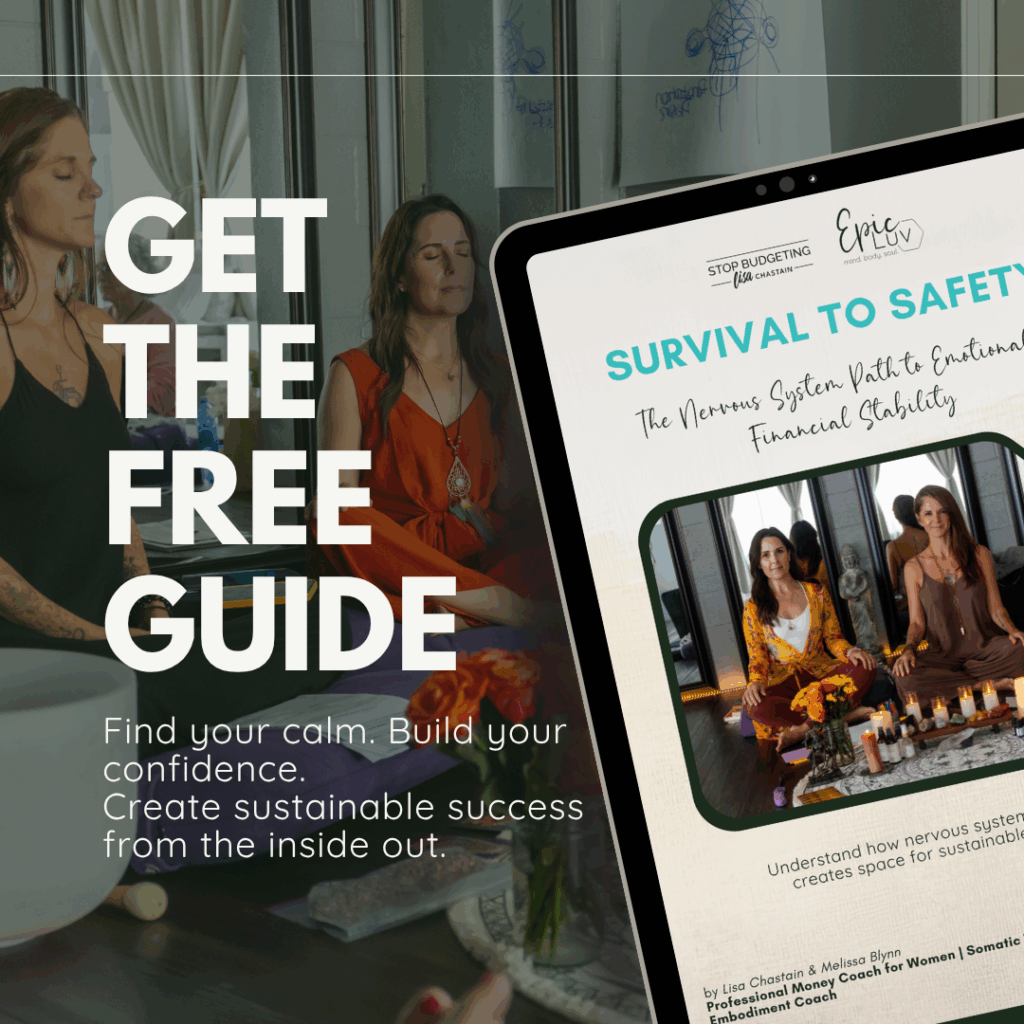
That’s why I created the free guide:
👉 Survival to Safety: The Nervous System Path to Emotional & Financial Stability
Inside, you’ll learn a simple, repeatable practice that helps you:
- Shift out of survival mode in real time.
- Restore a felt sense of safety in your body.
- Build lasting emotional capacity to hold more — without overwhelm.
- Create the foundation for true financial and personal stability.
Because the goal isn’t to “fix” your relationship with money.
It’s to feel safe enough to have one.
The Embodied Path to Wealth
As women, many of us inherited a model of success built on overdrive — pushing harder, earning more, never pausing to receive.
But the feminine nervous system thrives in rhythm, not rush.
When we learn to honor our body’s cues — to rest, regulate, and receive — we don’t just feel better.
We become better stewards of our energy, time, and money.
Embodiment is the new wealth strategy.
When your nervous system is anchored in safety:
- You stop reacting to scarcity.
- You start responding from sufficiency.
- You naturally make choices aligned with your long-term stability — not your short-term stress.
That’s what it means to build capacity.
To expand what you can hold without collapsing, constricting, or controlling.
Join Us Live: The Capacity Lab

If this conversation is landing for you — if you’re ready to stop hustling for safety and start building it from within — join Lisa Chastain and me for our free live workshop:
🌿 The Capacity Lab: Build Inner Safety to Hold More Wealth, Emotion & Energy — Without Overwhelm
📅 Tuesday, November 12 at 5:30 PM PST
🎟️ Register Here
In this 60-minute experience, you’ll learn:
- What titration is — and why it’s the secret to expanding your capacity.
- Why your body resists growth when it doesn’t feel safe?
- The link between nervous-system regulation and emotional + financial security.
- Somatic practices to help you hold more without burning out or shutting down.
This isn’t about doing more.
It’s about feeling safe enough to receive more.
✨ Ready to Begin?
- Download your free guide: Survival to Safety
- Watch: Money Is Emotional on YouTube
- Join us live: The Capacity Lab — Nov 12, 5:30 PM PST
Your next level of wealth isn’t about doing more.
It’s about feeling safe enough to hold it.
Leave a Reply